
APOS 2026 Key Insights: IP, Sports and AI Are Reshaping Asia’s Content Industry

Share
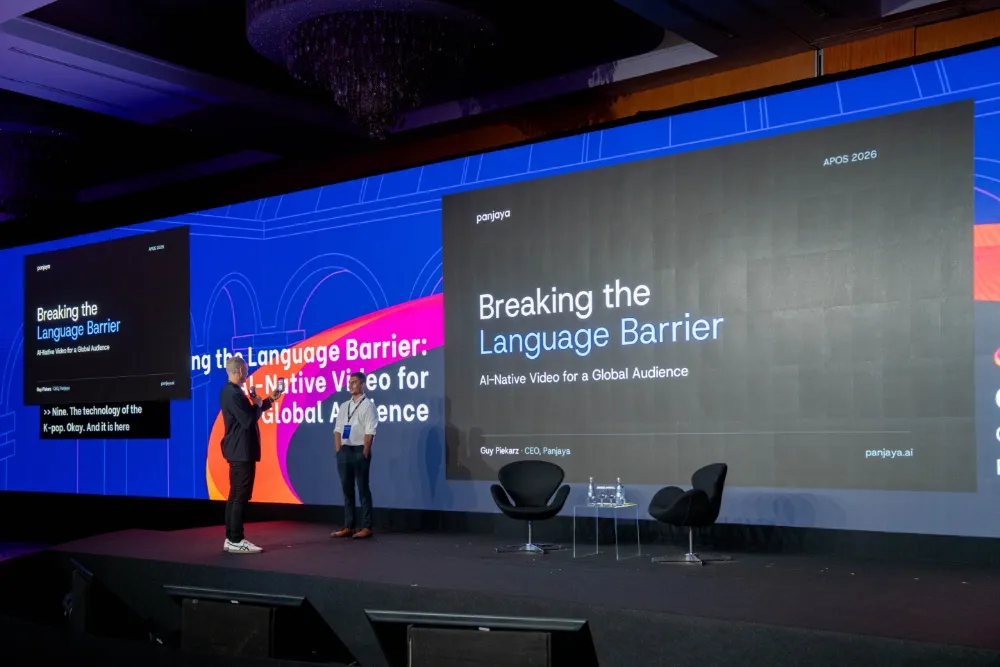
Asia’s entertainment sector is entering a new phase of development. While growth remains a priority, executives attending this year’s APOS conference in Bali focused largely on building sustainable business models, scalable intellectual property, and stronger audience relationships. Several major themes emerged throughout the event, highlighting the direction the industry is taking.
Intellectual Property Is Emerging as the Industry’s Most Valuable Asset
One of the strongest messages throughout the conference was the growing importance of intellectual property ownership. Whether discussing the renewed popularity of Japanese live-action productions and Chinese-language content on Netflix or the international ambitions of MD Entertainment, speakers repeatedly emphasized that owning and developing IP has become essential.
The industry’s focus is increasingly shifting toward creating franchises that can succeed across multiple platforms, territories, and formats. Minyoung Kim, Netflix’s Vice President of Content for Asia-Pacific excluding India, explained that she views herself and her team as portfolio managers, carefully balancing investments across key markets such as South Korea, Japan, and India.
During the “Indonesia At Scale” session, MD Entertainment founder and CEO Manoj Punjabi noted that global streaming platforms have played a critical role in bringing Indonesian stories to worldwide audiences. He added that future expansion will increasingly rely on international collaborations and cross-border IP development.
Artificial Intelligence Is Becoming Core Infrastructure
Artificial intelligence was no longer treated as a futuristic concept or experimental technology. Instead, it was discussed as an operational tool that is already transforming media businesses.
Vivek Couto, CEO of Media Partners Asia and organizer of APOS, established this theme in his opening remarks, arguing that AI has moved beyond theoretical discussions and become a practical reality across the industry.
JioHotstar provided a clear example of this shift. Chief Architect Vijay Seshadri revealed that the platform has introduced a conversational voice-search feature powered by OpenAI technology. According to him, more than 60% of users now prefer voice commands instead of text when searching for content.
Meanwhile, ReelShort described AI as a future production partner that will work alongside traditional live-action filmmaking. The conference also featured an extensive series of discussions dedicated to generative AI, including sessions on AI-powered content creation, localization, video generation, and production workflows. Such a comprehensive focus on AI would have been unimaginable at previous editions of APOS.
Fandom Has Become a Business Model, and Sports Demonstrate Its Potential
The growing economic value of fandom was another major theme throughout the summit.
Crunchyroll’s continued expansion into Taiwan and South Korea highlighted how dedicated fan communities are increasingly viewed as long-term business opportunities rather than simple marketing successes.
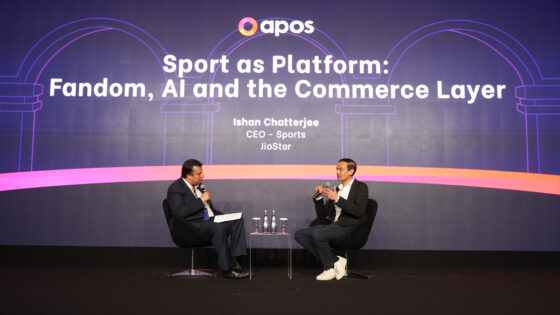
Sports provided perhaps the clearest example of this trend. Ishan Chatterjee, CEO of JioStar Sports, revealed that the platform now attracts more than one billion viewers during each Indian Premier League season, reaching 1.2 billion viewers in 2026. He also noted that the ICC Men’s T20 World Cup Final in 2026 generated a record-breaking 72.5 million simultaneous digital viewers.
According to Chatterjee, live sports remain one of the few content categories capable of gathering audiences at such enormous scale. He pointed to JioStar’s long-term investment in kabaddi, which now attracts over 300 million viewers each season, as proof that sports fandom can be built successfully from the ground up.
He also discussed the company’s growing commerce strategy, highlighting a partnership with food delivery platform Swiggy that combines content consumption with transactional experiences.
Ahead of the summit, Vivek Couto pointed to cricket’s expanding international appeal as further evidence of sports’ growing influence. He noted that recent ICC tournaments generated meaningful demand in markets such as Japan, Indonesia, and Thailand for the first time, raising new questions about monetization opportunities through merchandise, ticket sales, brand partnerships, and sponsorships.
Vertical Entertainment Is Becoming a Major Industry Segment
Executives also emphasized the rapid rise of vertical-format entertainment.
From ReelShort’s expansion throughout Southeast Asia to FlareFlow’s efforts to build vertical reality-show franchises, industry leaders increasingly described vertical storytelling as a permanent content category rather than a temporary trend.
The financial results support this optimism. According to Media Partners Asia, DramaBox and ReelShort, currently the two most profitable companies in the microdrama sector, are generating nearly $1.5 billion in combined annualized revenue. Most of their users are located in the United States.
During the conference, ReelShort announced a new partnership with Philippine telecommunications provider Globe, following a similar agreement with Thailand’s AIS earlier this year.
Speaking at the “Building the Vertical Stack in Asia” panel, Timothy Oh, General Manager and Chief Marketing Officer of COL Group International, explained that the industry is already witnessing the emergence of vertical documentaries, vertical intellectual properties, and vertical entertainment franchises.
Separately, RisingJoy CEO and co-founder Cassandra Yang unveiled RJOY, a new direct-to-consumer microdrama platform that will launch through TikTok Minis in both the United States and Japan. The service plans to release 20 original productions during the second half of 2026.
Connected Television Is Transforming Viewing Habits Across Asia
Several sessions highlighted the rapid growth of connected television as audiences increasingly consume digital content on larger screens.
Gunjan Soni, Managing Director of YouTube India, stated that YouTube now achieves the highest reach among media platforms on connected TV devices in India, according to Comscore data. She described the platform as India’s new prime-time destination.
Creator-driven cricket content alone generated approximately 190 billion views on YouTube during 2025. Notably, 66% of total viewing time came from non-live content, including analysis programs and behind-the-scenes features.
JioHotstar executive Bharath Ram pointed to the presence of nearly 100 million connected televisions across India as evidence of the platform’s growing focus on CTV audiences.
Soni added that YouTube now reaches more than 75 million Indian adults aged 18 and older through connected TV devices. Together, these figures suggest that assumptions about Asia being solely a mobile-first market are rapidly changing.
Governments Are Actively Competing for Streaming Investments
One of the newer developments highlighted at APOS 2026 was the increasing involvement of governments seeking to attract production investments.
Jakarta Vice Governor Rano Karno attended the conference to introduce a six-point strategy aimed at positioning Indonesia’s capital as a major production center.
At the heart of the initiative is a tax incentive program that will provide eligible national film productions with rebates covering up to 50% of costs incurred within Jakarta. The program is scheduled to launch officially on June 26.
Karno also held meetings with senior Netflix executives regarding the possibility of expanding the company’s production activities in the city.
The initiative demonstrates how governments throughout Asia are increasingly treating content production as an important driver of economic growth and job creation.
The Creator Economy Has Become a Significant Economic Force
The creator economy was discussed not simply as a marketing tool but as a major economic sector in its own right.
Gunjan Soni argued that India has become a model for how creator-driven ecosystems can achieve large-scale institutional growth.
According to YouTube, approximately 200 million logged-in users searched for shopping-related content on YouTube India during 2025. This activity contributed to a 250% year-over-year increase in shopping-related viewing time.
The ability of creators to directly influence purchasing decisions emerged as one of the most commercially important developments discussed throughout the conference, demonstrating how content and commerce are becoming increasingly interconnected.
Asia Is Evolving From a Market Into a Global Growth Engine
A final theme running through the conference was the growing international influence of Asian content.
As Netflix marked its tenth year of operations in Asia-Pacific, the company released new data showing that content from the region now accounts for more than half of all titles appearing in its global non-English Top 10 rankings each week. This figure has increased significantly from roughly 30% in 2021.
Netflix also reported that viewing hours for Asia-Pacific content have quadrupled since 2019.
Executives from Prime Video, Disney, and several regional platforms similarly emphasized the expanding global demand for Asian stories.
In his opening address, Vivek Couto challenged the common narrative that the entertainment industry is being disrupted or reset. Instead, he argued that a more accurate description is that the industry is being fundamentally redefined.
According to Couto, new possibilities, emerging revenue streams, and evolving cost structures are reshaping the entire entertainment landscape. APOS 2026 demonstrated that Asia is no longer simply participating in this transformation—it is increasingly driving it.